
Antenna decoupling
Antenna decoupling (or antenna cross-talk reduction) is a set of techniques, based on physical and technical mechanisms, used to minimize interference between multiple antennas in an RF system. This ensures optimum performance in terms of radiation and reception, while preserving signal integrity. In modern environments, effective cross-talk reduction is essential to maximize the performance of communication systems.

How it works?
Antennas can be characterized by several criterias indicating the impact of their coupling:
- Impedance matching, which determines their radiation frequencies.
- Radiation pattern shows how energy is transmitted/received in different directions, enabling analysis of how the antenna radiates or picks up RF signals;
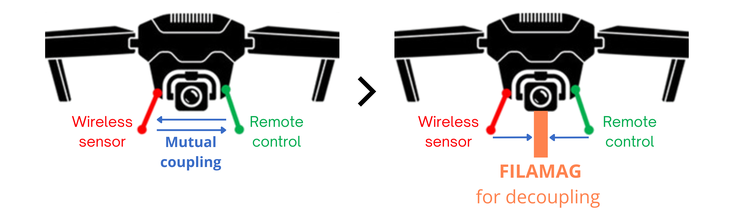
The cross-talk between antennas can have a significant impact on their resonant frequency. This can lead to a shift outside the frequency band originally intended, and cause distortion of the radiation pattern.
When to apply?
Multi-antenna communication systems
Reduction of interference between MIMO antennas to improve throughput and signal quality in wireless communication systems requiring multiple antennas
Antenna arrays
Reduction of cross-talk between antennas to maintain acceptable performance while reducing the overall footprint in antenna arrays.
Radar and navigation systems
Cross-talk reduction between transmitting and receiving antennas to avoid signal distortion in radar, GNSS and other navigation systems.
Densely populated RF environments
Applications in RF-saturated environments, such as industrial networks and smart cities to ensure efficient coexistence of multiple antennas.
What's the HYMAG'IN's point?

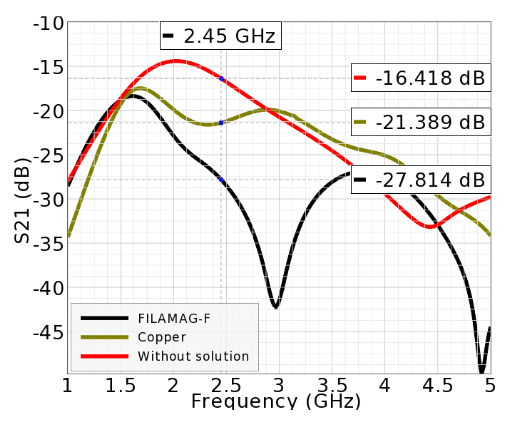
Fig. 3: Mutual coupling (transmission coefficient) between two antennas
With FILAMAG-F, the transmission coefficient improves from -16.4 dB to -27.8 dB, at the Wi-Fi frequency, corresponding to a 69.4% reduction in coupling.
Our cross-talk reduction methods can be adapted to the space available and to your systems.
How can FILAMAG-F, our 3D-printed microwave absorber, meet the need?
- Large frequency coverage, for reliable performance across multiple bands.
- Adaptability, with 3D printing that tailors the product to your needs and fits into existing cavities.
- A compact form, making it easy to integrate into tight spaces.
- Significantly reduced delivery times, so you’ll have your projects up and running in record time

Navigation
What about HYMAGIN?
HYMAG'IN combines RF engineering expertise with advanced magnetic materials to help engineers solve their electromagnetic challenges. We offer both off-the-shelf absorbers and fully custom solutions, available as filaments, pellets, resins, inks and powders.
Every solution is validated by RF simulations and measurements, and manufactured in France.
