
EMI Shielding
Electromagnetic shielding creates a physical barrier that prevents RF waves from propagating through it, either protecting sensitive electronics inside an enclosure from external interference, or preventing internal emissions from leaking out into surrounding systems.
Unlike RF absorption, which dissipates all incident energy as heat, shielding acts primarily by reflecting waves at the material's interface, with a complementary absorbing component that determines how much energy is actually eliminated rather than redirected.
Standard metallic shields are highly effective at blocking transmission, but come with a fundamental problem: the energy they reflect doesn't disappear. It bounces inside the enclosure, generating standing waves, internal resonances, and additional interference that can disturb the very components the shield was meant to protect.
HYMAG'IN's shielding solutions (LOWRA (1–50 GHz) and MILLIWAVE (50–100 GHz)) address this by combining shielding effectiveness with a significant absorbing component (40 to 80% of incident energy dissipated).
The result: a cleaner RF environment inside your enclosure, at 7 to 8 times lower weight than solid metal.
How it works?
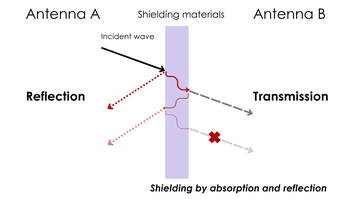
Shielding Effectiveness (SE), measured in dB, results from three simultaneous phenomena:
Reflection at the first interface: Part of the incident wave is immediately reflected. In metal, this dominates. In LOWRA and MILLIWAVE, reflection is deliberately reduced, the material is semi-transparent to the incoming wave, which it then absorbs before any significant transmission occurs.
Absorption through the material: As the wave travels through the polymer composite, dielectric losses (ε'') progressively dissipate its energy as heat. LOWRA converts 40 to 80% of incident energy this way, fundamentally different from metal, which mainly redirects.
Multiple internal reflections: Residual reflections inside the material create additional attenuation paths, particularly relevant at higher frequencies.
A specific case: shielding leakage at apertures In practice, no enclosure is perfectly sealed. Ventilation slots, connector feedthroughs, assembly joints and cable apertures all create electromagnetic leakage paths, and these are often the dominant EMC issue in real-world systems, not the shielding panel itself.
When to apply?
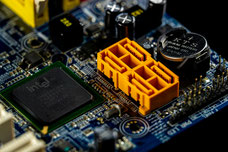
- Embedded systems & RF oscillator enclosures Power amplifiers, RF oscillators and high-frequency switching circuits emit radiation that propagates through metal housings and disturbs neighboring circuits. LOWRA provides effective shielding with an absorbing component that eliminates internal standing waves? in a fraction of the weight of solid metal housings.
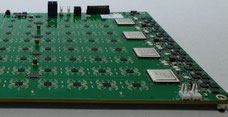
- Multi-antenna compact platforms In drones, IoT devices, satellites and automotive systems, multiple antennas sharing the same platform create electromagnetic crosstalk between modules. LOWRA partitions between antenna systems, reducing coupling by -10 to -50 dB with thicknesses of 1 to 5 mm.
- Automotive radar & mmWave systems (50–100 GHz) At frequencies above 40 GHz (automotive radar, satcom links, 5G and 6G) conventional shielding materials lose effectiveness. MILLIWAVE is specifically engineered for the 50 to 100 GHz range, with stable dielectric properties across the entire band and attenuation increasing with frequency.

- Industrial & aerospace electronics Applications requiring documented traceability, repeatable performance and consistent RF properties across production batches. LOWRA and MILLIWAVE are manufactured in France with characterized RF and physical properties per batch.

What's HYMAG'IN's point?
LOWRA - 1 to 50 GHz
- Up to 35 dB shielding attenuation
-
40 to 80% absorbing component — reduces internal resonances that metal cannot eliminate
-
7 to 8x lighter than solid metal for equivalent shielding
-
Metal-free loaded polymer
-
Antenna isolation: -10 to -50 dB, 1 to 5 mm thickness
-
Available as filament and pellets

MILLIWAVE - 50 to 100 GHz
-
Designed for automotive radar (77 GHz), satcom and 5G/6G mmWave
-
Stable ε' across the full 50–100 GHz band
-
Attenuation increasing with frequency
-
Compatible with standard FDM 3D printers, complex geometries printable directly
-
Available as filament and pellets

Navigation
What about HYMAGIN?
HYMAG'IN combines RF engineering expertise with advanced magnetic materials to help engineers solve their electromagnetic challenges. We offer both off-the-shelf absorbers and fully custom solutions, available as filaments, pellets, resins, inks and powders.
Every solution is validated by RF simulations and measurements, and manufactured in France.
