
RF Load
Microwave loads are essential components in RF systems and waveguides. They are used to dissipate electromagnetic energy and prevent unwanted reflections that could disrupt measurements or the operation of electronic equipment.
In many RF systems, poor impedance matching can cause wave reflections, leading to measurement errors, instability, or performance degradation
Reflections in RF Systems
When an electromagnetic wave propagates in a waveguide and encounters a poorly matched termination, part of the energy is reflected back toward the source.
These reflections can lead to several issues :
WAVE REFLECTIONS
Poor impedance matching causes RF energy to return toward the source.
MEASUREMENT INSTABILITY
In RF test systems, reflections disturb measurements and reduce accuracy.
SYSTEM DISTURBANCES
Reflected energy can affect the overall operation of the system and degrade performance.
Principle of a Microwave Load
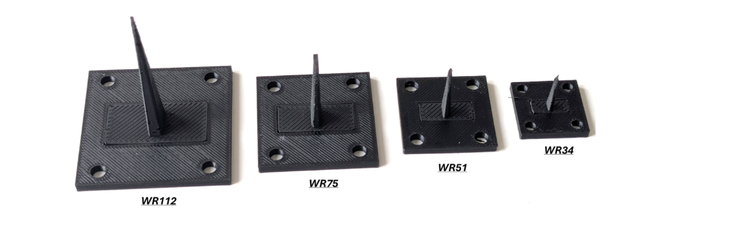
A microwave load is designed to absorb electromagnetic energy in order to prevent reflections.
To achieve this, it uses an absorbing material capable of converting RF energy into heat, which allows the incident power to be efficiently dissipated.
In this study, the load is manufactured using a composite filament filled with magnetic particles, providing dielectric and magnetic losses favorable to electromagnetic wave absorption.
The pyramidal geometry of the load also ensures a gradual impedance transition, helping to reduce reflections within the waveguide.
Measured Performance
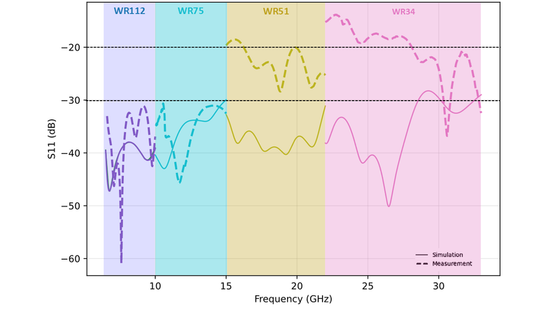
RF performance was evaluated in several waveguides covering a frequency range from 6 to 33 GHz.
The results show:
-
Very good impedance matching up to about 15 GHz, with reflections below −30 dB.
-
Satisfactory performance up to around 22 GHz, with reflections typically below −20 dB.
HYMAG'IN’s Approach
HYMAG'IN develops 3D-printed microwave loads using a composite absorbing filament.
This approach offers several advantages :
RAPID PROTOTYPING
Fast manufacturing of RF loads adapted to experimental systems.
COST REDUCTION
A more flexible and cost-effective alternative to conventional manufacturing methods.
DESIGN FLEXIBILITY
Additive manufacturing allows the geometry to be easily adapted to different waveguides and RF applications.

Navigation
What about HYMAGIN?
HYMAG'IN combines RF engineering expertise with advanced magnetic materials to help engineers solve their electromagnetic challenges. We offer both off-the-shelf absorbers and fully custom solutions, available as filaments, pellets, resins, inks and powders.
Every solution is validated by RF simulations and measurements, and manufactured in France.
